




Now that generative AI is capable of instantly creating legal documents, are you wondering whether dedicated estate planning software is still a valuable investment for your practice?
While it can be a powerful tool for streamlining legal research, crafting client communications, or scaling your marketing efforts, generative AI has limitations and liabilities that estate planning drafting software is designed to eliminate.
At a Glance
- AI can support firm operations and research, but using it to draft complex legal documents carries risks that many firms do not fully appreciate.
- The right estate planning software provides more than just reliable documents—it streamlines workflows, improves client experience, and drives practice growth.
- Not all document libraries are equal. How they are maintained impacts practices more than attorneys may realize.
- Privacy and security gaps in estate planning software can carry serious consequences that extend far beyond a data breach.
- The ideal software subscription can include valuable benefits that many firms neglect to ask about.
Why AI Cannot Replace Dedicated Estate Planning Software
Estate planning demands exceptional precision. Even a minor drafting error or overlooked provision can have serious consequences, including unintended tax exposure, conflicting distribution provisions, or the accidental disinheritance of a loved one. And every time you create an estate plan for a client, you make a bet that what you have just drafted is airtight and meets your ethical obligation of attorney competence.
Protecting a client’s legacy requires more than generating provisions that sound legally correct. Safeguarding a client’s legacy with certainty requires documents that are meticulously maintained and updated by experienced attorneys to account for state-specific requirements, changes in the law, and evolving planning strategies. Purpose-built estate planning software provides the structured drafting framework needed to support that work.
Generative AI does not currently offer the same level of consistency or reliability. In fact, using public large language models can introduce significant risks, such as producing contradictory statements in documents , omitting important language, inventing legal authorities, or failing to recognize how one drafting decision affects provisions elsewhere in the plan. Using public or unapproved AI platforms may also create confidentiality, data security, and professional responsibility concerns when client information is entered without appropriate safeguards. Furthermore, while AI can instantly create documents, verifying its output requires attorneys to spend valuable time manually auditing for errors. Attorneys have already been sanctioned for submitting AI-generated briefs containing nonexistent cases and inaccurate authorities, including in Mata v. Avianca; LNU v. Blanche; and Stephen McCarthy, P.A. v. Ironshore Specialty Insurance Co. Importantly, these decisions reinforce that the attorney, and not the technology, remains responsible for the accuracy of the final work product.
In contrast, dedicated estate planning software offers templates and logic specifically designed for legal drafting; it produces consistent, reliable documents and reduces the time spent on manual auditing. It also provides attorneys with a central, organized location to access and update estate plans over time by keeping client data within a secure system rather than exposing it to a third-party platform.
What to Look for in a Document Library
When evaluating estate planning drafting software, the value of your investment lies in the quality and depth of its documents. The software must reliably meet your clients’ needs today while providing the versatility that your practice requires to adapt and grow tomorrow.
Is the software consistently maintained by knowledgeable professionals?
To ensure document integrity, verify that experienced estate planning attorneys are involved in creating and updating the document templates.
Laws change, administrative regulations shift, and court rulings redefine legal standards. Software that relies solely on technical developers without active attorney oversight risks leaving firms with outdated or flawed language. Modern practices require tools that evolve not only with statutory updates but also with emerging best practices and changing client preferences.
Does it accommodate state-specific planning?
Estate planning is inherently state specific. Although certain legal principles apply across jurisdictions, laws governing property rights, trust administration and enforcement, taxation, creditor protection, and document execution vary significantly from one state to another. Effective planning, therefore, requires documents and drafting tools tailored to the laws of the client’s jurisdiction.
Failure to account for local nuances can render a critical document invalid or trigger avoidable tax penalties. The right drafting software must provide robust, state-specific clauses and execution options tailored to your jurisdiction. Built-in locally compliant provisions ensure that your documents are upheld and your clients’ assets remain protected under their state’s specific framework.
Does the software have the flexibility to serve a diverse range of clients?
A software platform with a limited selection of basic documents can restrict the types of clients you can serve or force you back into manual drafting.
Access to an expansive, versatile document library allows your firm to confidently address a wide spectrum of client goals and circumstances. Whether a client needs a revocable living trust or advanced tax-planning instruments such as a grantor-retained annuity trust (GRAT), your software should offer options to effectively execute those strategies. A comprehensive library gives your practice the flexibility to serve a diverse range of clients without compromising precision or speed.
What Additional Tools Does the Software Offer?
While ironclad document templates are the backbone of estate planning drafting software, modern platforms offer features that optimize practice operations. The right software should elevate and streamline your entire workflow, reduce administrative friction, and improve the client experience.
Does the software offer tools for client intake?
A smooth intake process benefits everyone involved and lays the foundation for a productive, lasting client relationship.
Drafting software that includes secure, intuitive, mobile-friendly intake tools creates a seamless experience for your clients while saving your firm valuable time. When intake forms automatically sync directly to your drafting software, you eliminate manual data entry, reduce errors, and accelerate the time it takes to produce an initial draft.
Does the software offer tools for visualizing the estate plan?
For many clients, reading dense and lengthy estate planning documents can feel overwhelming. Complex legal terminology and provisions can often leave clients unsure how their estate plan actually functions.
Platforms that generate visual diagrams can help bridge this gap by translating complex trust structures, fiduciary roles, and distribution plans into clear, easy-to-follow roadmaps. These visuals can strengthen clients’ understanding of their estate plans, build confidence in their decisions, and make the document review process more efficient and engaging.
Does the software use AI-powered features appropriately?
AI capabilities can improve practice efficiency by helping to complete tasks such as summarizing case details, accelerating legal research, and supporting marketing efforts, but security must remain nonnegotiable.
If a drafting software offers AI features to support your workflow, it is crucial to verify that the tools operate within a strict closed-loop environment. This allows your practice to leverage AI capabilities while maintaining absolute data privacy.
How Does the Software Protect Your Client’s Privacy?
For estate planning attorneys, protecting sensitive client information is far more than a matter of risk management—it is an ethical responsibility. Estate planning documents may contain some of the most sensitive details an individual can share. Safeguarding this information is essential to maintaining client trust and fulfilling your professional duty to prevent the unauthorized disclosure of confidential information.
Choosing software that prioritizes security is essential for preventing data breaches that can damage your firm’s reputation and expose your clients to severe risk.
Does the software hold SOC 2 Type 2 compliance?
Not all security credentials carry the same weight. When reviewing software providers, you will often see claims of “SOC 2 compliance,” but it is critical to distinguish between SOC 2 Type 1 and SOC 2 Type 2 certifications.
- SOC 2 Type 1 evaluates a software company’s security controls at a single point in time. It merely confirms that the provider’s security measures were properly maintained on the day of the audit.
- SOC 2 Type 2 assesses security and privacy controls over an extended observation period, typically lasting from 3 to 12 months, to confirm that the security protocols operate effectively in daily practice.
Opting for software that has earned SOC 2 Type 2 compliance provides you with verified assurance that the vendor maintains continuous, active data safeguards, rather than a temporary snapshot of compliance.
Are Additional Helpful Resources Available?
Rather than being a simple one-time technology investment, investing in estate planning drafting software establishes an ongoing partnership with your vendor. Even the most sophisticated platform loses value if your team struggles to navigate its features or lacks timely assistance when you need it most. To ensure that your firm gets the highest return on its investment, evaluate the support team and the professional resources available.
Does the software company offer dedicated training and support?
Adopting any new technology involves a learning curve for attorneys and administrative staff. Selecting a platform that provides structured onboarding, live training, and easily accessible customer support helps facilitate a smooth transition.
When you are working under a tight client deadline, responsive and knowledgeable support is essential. Vendors that prioritize dedicated customer service can help your firm minimize downtime, resolve issues quickly, and maximize the platform’s value.
What professional resources are included?
The top software providers serve as strategic partners in your practice’s growth. When comparing them, evaluate the professional development resources included with your subscription.
Many leading platforms offer CLE-eligible educational opportunities, including webinars and intensive multiday programs, that share real-world insights and strategies to help you expand your offerings, stay informed about legislative changes, and hone your expertise.
In addition, some subscriptions include access to exclusive peer networks and practitioner communities, creating a dedicated space to collaborate, share best practices, exchange ideas, and ask important questions.
Together, these resources transform your software investment into an invaluable asset for long-term professional and practice growth.
Invest in the Future of Your Practice
Generative AI will continue to change the legal landscape, but dedicated estate planning drafting software remains an indispensable tool for navigating the complex nuances of this practice area with confidence.
Investing in the right drafting software can often offer additional resources to support your practice’s growth and long-term success beyond producing ironclad documents that provide peace of mind. From improving workflow efficiency and client experience to CLE-eligible educational opportunities and a community of peers at your fingertips, the ideal platform can elevate every facet of your estate planning practice.
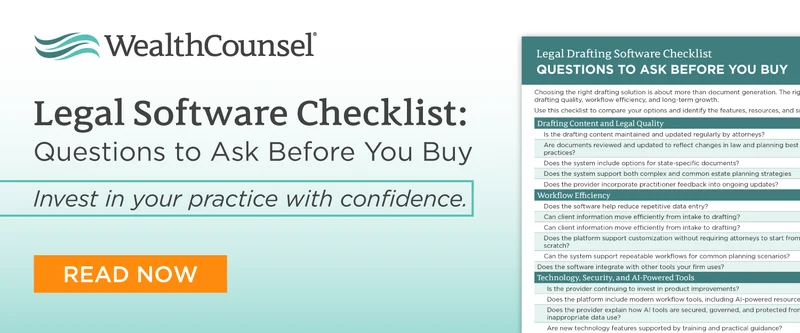
To help you systematically evaluate your options and ask the right questions during platform demos, download our “Legal Software Checklist: Questions to Ask Before You Buy” and make an informed, strategic investment for your practice.
.png)