



Jeremiah W. Doyle IV, Esq.
Fiduciary income tax planning is one of the most complex yet rewarding areas of tax planning. When an individual creates an irrevocable nongrantor trust, that trust becomes a separate tax-paying entity subject to Subchapter J of the Internal Revenue Code (I.R.C.). While trusts offer unparalleled advantages in asset protection, estate tax exclusion, and generational wealth structuring, they face a severe disadvantage of compressed tax rates under the federal income tax regime.
A nongrantor trust reaches the highest federal marginal tax bracket for 2026 with a taxable income of $16,000—a mere fraction of the income required for an individual filer to reach income taxation in the highest bracket. Left unmanaged, a trust that accumulates income can needlessly pay more income tax than is optimal.
Fortunately, Subchapter J provides a number of statutory options allowing a trust to reduce this tax burden. Those options include the income distribution deduction allowed under I.R.C. §§ 651 and 661, the 65-day rule under § 663(b), the § 642(c) income tax charitable deduction, the § 678 powers of withdrawal, the § 643 rules relating to property distributions, and the ability to include capital gains in distributable net income (DNI). These options can allow fiduciaries to dramatically minimize or completely eliminate a trust's internal income tax burden.
The Problem: Compressed Fiduciary Income Tax Brackets
To understand why mitigation strategies are vital, one must first examine the stark reality of how estates and nongrantor trusts are taxed. Under the federal income tax framework, the ordinary income tax rates applied to trusts and estates utilize four tax brackets: 10 percent, 24 percent, 35 percent, and 37 percent, but the brackets are highly compressed.
The highest federal marginal income tax rate of 37 percent applies to trusts at $16,000 of taxable income at 2026 rates. Furthermore, the 3.8 percent net investment income tax (NIIT) under § 1411 is also triggered at the same $16,000 of taxable income. The maximum 20 percent rate for long-term capital gains and qualified dividends kicks in at a slightly higher amount of taxable income of $16,250 in 2026.
An individual, on the other hand, does not reach the same 37 percent marginal tax bracket in 2026 until their taxable income reaches $768,700 (married filing joint), $640,600 (single), $384,350 (married filing separate), and $640,600 (head of household).
Strictly from a tax point of view, making discretionary distributions to beneficiaries can shift the tax burden from the trust to the individual beneficiaries who will most likely be in lower tax brackets . . .
Want to read the rest? This article will appear in full in the Fall issue of the WealthCounsel Quarterly—the legal magazine for estate planning and elder law attorneys! Subscribe for free today to get instant access to our current issue, then on October 16, you'll receive the Fall issue featuring this complete article.

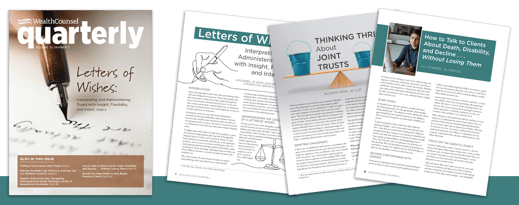
What's Inside the Fall Issue—Releasing October 16
This issue of the WealthCounsel Quarterly tackles a theme every estate planning and elder law attorney knows well: how to plan for circumstances that can’t fully be known in advance. Here is a preview of what’s inside:
- Compressed trust tax brackets: Jeremiah Doyle’s cover article (the one you’re reading now!) walks through the statutory toolkit—including the income distribution deduction, the 65-day rule, and Internal Revenue Code §§ 642(c), 678, and 643(e)—that helps fiduciaries land on the most tax-efficient outcome for irrevocable trusts.
- Medicaid payback—loan, not gift: Zachary Bloxham breaks down how to think about Medicaid estate recovery, offering a framework for drafting compliant instruments today for a claim that may surface years from now.
- Disclaimer planning and the Clayton election: Phoebe Stone explores how married couples can defer allocating assets between marital and nonmarital shares until circumstances are fully known after the first spouse’s death.
- Spotting undue influence: Professor Roberta Flowers catalogs the warning signs, such as isolation, unusual distributions, and beneficiary involvement, and shares practice pointers to protect clients and defend against future litigation.
- The shifting noncompete landscape: Ryan Snow surveys the patchwork of state noncompete bans and reviews alternatives like nondisclosure agreements, nonsolicitation covenants, and retention incentives.
- AI as an equalizer for small firms: Jessica Spenik makes the case for AI handling intake, marketing, and meeting notes—freeing attorneys to focus on the counseling and judgment no tool can replace.
Subscribe for free to get this issue delivered straight to your inbox on release day.